
 Admin
Admin Feasibility Study of Chlorine Manufacturing, Filling, and Packaging: From an Essential Product to a High-Return Industrial Project
Chlorine is no longer a simple product used only for daily cleaning. It has become a strategic material within modern sanitation and hygiene systems for homes, factories, hospitals, food facilities, and large service companies. This widespread and continuous daily use has made chlorine manufacturing one of the most stable and profitable industrial projects—especially when production, filling, and packaging are combined within an integrated production line capable of serving both household and industrial markets.
Factories that treat chlorine as an investment product understand that real strength lies not only in manufacturing, but in managing the entire system—from mixing to delivering a final, well-packaged product to the market with consistent quality and a professional appearance.
Why Is the Chlorine Project Considered One of the Lowest-Risk Industrial Investments?
Chlorine is used daily and year-round in:
-
Household cleaning
-
Surface disinfection
-
Food processing factories
-
Hospitals and medical centers
-
Swimming pools
-
Cleaning and facility management companies
This wide range of applications ensures:
-
Continuous demand
-
Easy marketing
-
Fast capital turnover
-
Revenue stability
These factors make chlorine manufacturing suitable for small, medium, and large factories alike.
The Difference Between Household Chlorine and Industrial Chlorine Within One Production System
One of the major advantages of this project is the ability to produce multiple products from the same production line with minor adjustments in concentration and packaging.
Household chlorine is produced at lower concentrations and packed in small bottles for daily use, while industrial chlorine is manufactured at higher concentrations and packed in large jerrycans or containers for institutional clients.
This diversification allows factories to expand their customer base without the need to build a separate facility.
Raw Materials and Basic Formula for Liquid Chlorine Production
Liquid chlorine used for cleaning is produced using a well-known industrial formulation based on:
-
Sodium hypochlorite
-
Purified water
-
Stabilizing agents for concentration control
-
Safety additives to improve storage stability
Precise control of mixing ratios and raw material quality directly affects:
-
Disinfection strength
-
Color stability
-
Shelf life
-
Market acceptance
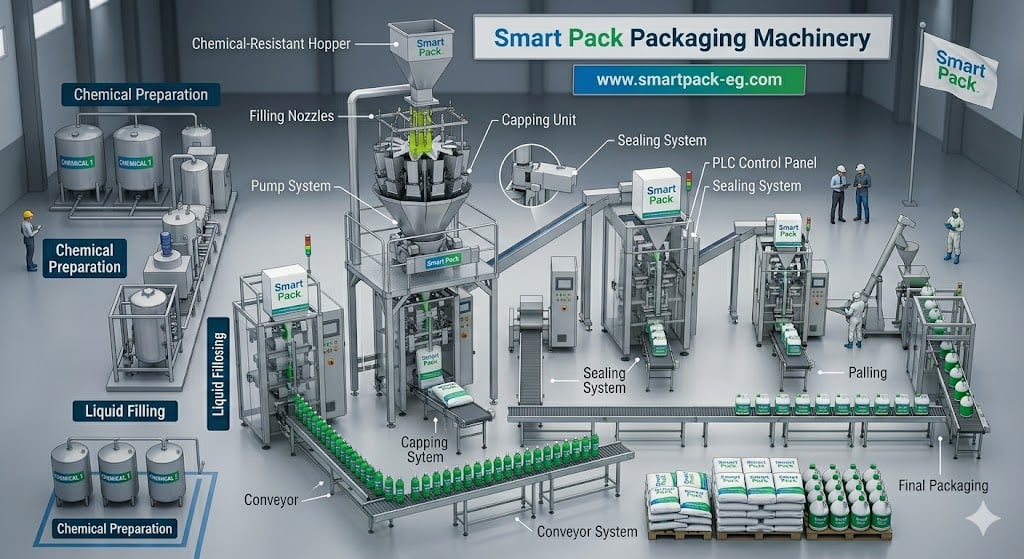
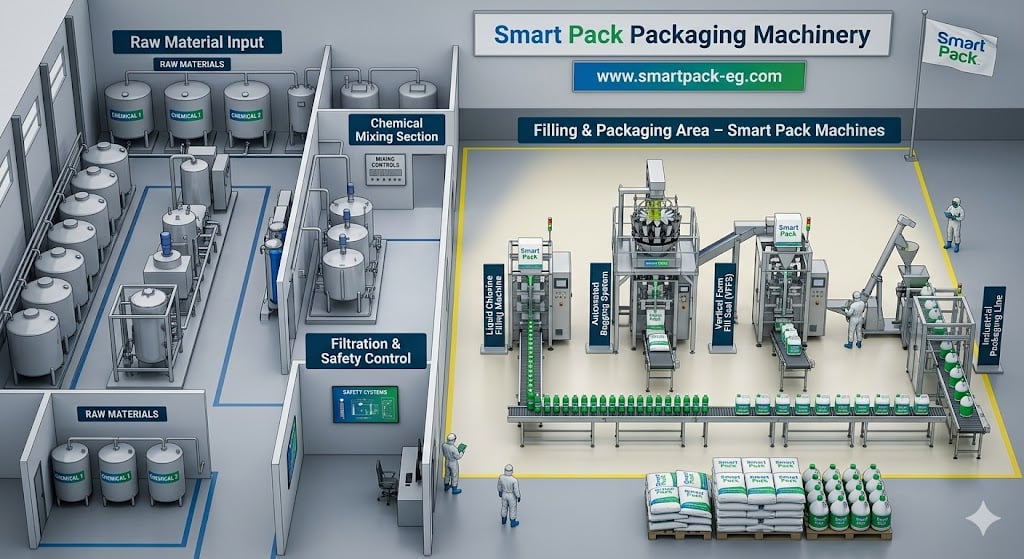
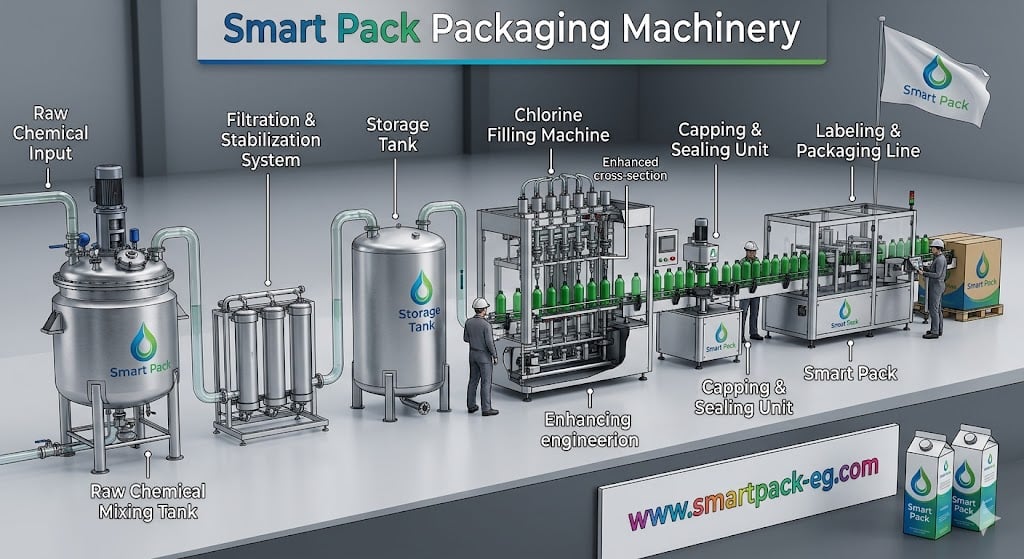
Industrial Manufacturing Stages of Chlorine Inside the Factory
The production process consists of interconnected stages that must be carefully managed to ensure a safe and effective product.
Preparation Stage
Raw materials are prepared and verified to meet specifications.
Mixing Stage
Chemical-resistant mixing tanks are used, with controlled time and concentration.
Testing and Quality Control
Concentration, stability, and effectiveness are verified before filling.
Filling and Packaging
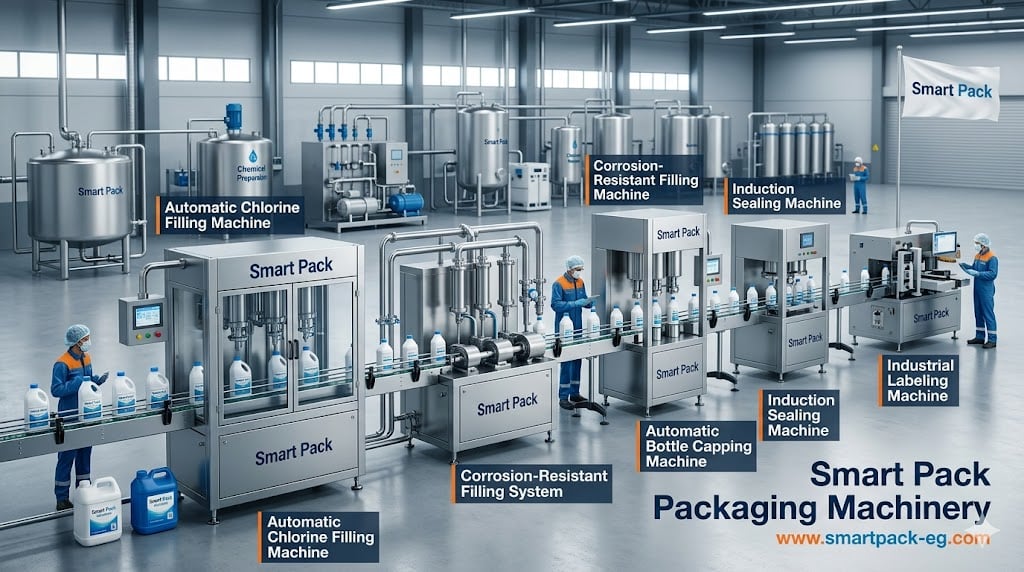
The finished product is transferred to filling lines designed for chemical liquids.
Filling and Packaging: The Turning Point from a Basic Product to a Commercial Success
In the chlorine market, packaging is not a cosmetic step—it is a core factor in:
-
Safe transportation
-
Ease of use
-
Customer trust
-
Distribution and export readiness
Filling and packaging machines ensure:
-
Accurate volume
-
Secure sealing
-
High production speed
-
Reduced product loss
Types of Filling Machines Suitable for Chlorine Factories
| Product Type | Machine Type | Application |
|---|---|---|
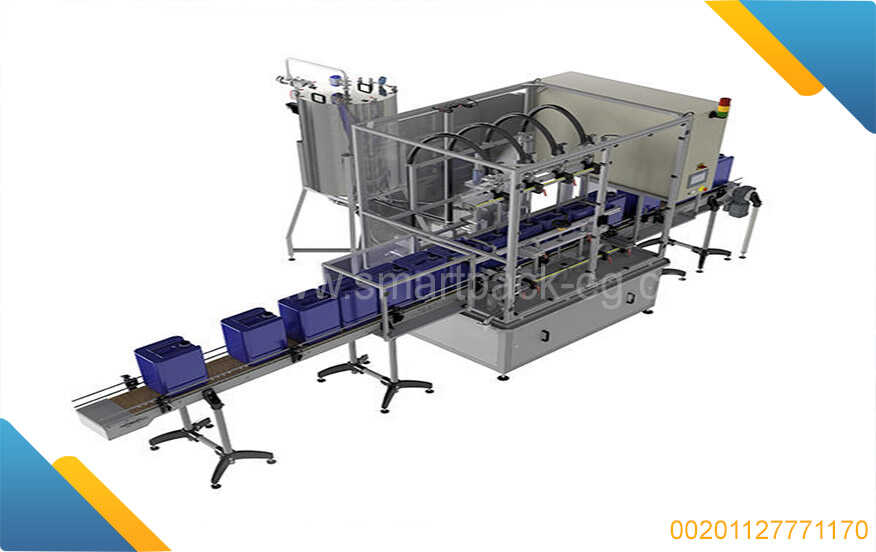
| Household chlorine | Automatic liquid filling machine | Small bottles |
| Industrial chlorine | Jerrycan filling machine | Large volumes |
| Mixed production | Integrated filling line | Flexibility and expansion |
| High-volume production | Fully automatic line | Supply contracts |
Machine selection should be based on the factory’s future growth plan—not only current production volume.
Integrated Production Lines: The Fastest Way to Reduce Costs and Increase Profit
Factories that rely on integrated production lines for chlorine manufacturing and packaging achieve:
-
Consistent quality
-
Fewer operational failures
-
Faster order fulfillment
-
Lower unit production costs
For this reason, smart factories prefer working with suppliers that deliver complete production line solutions rather than isolated machines.
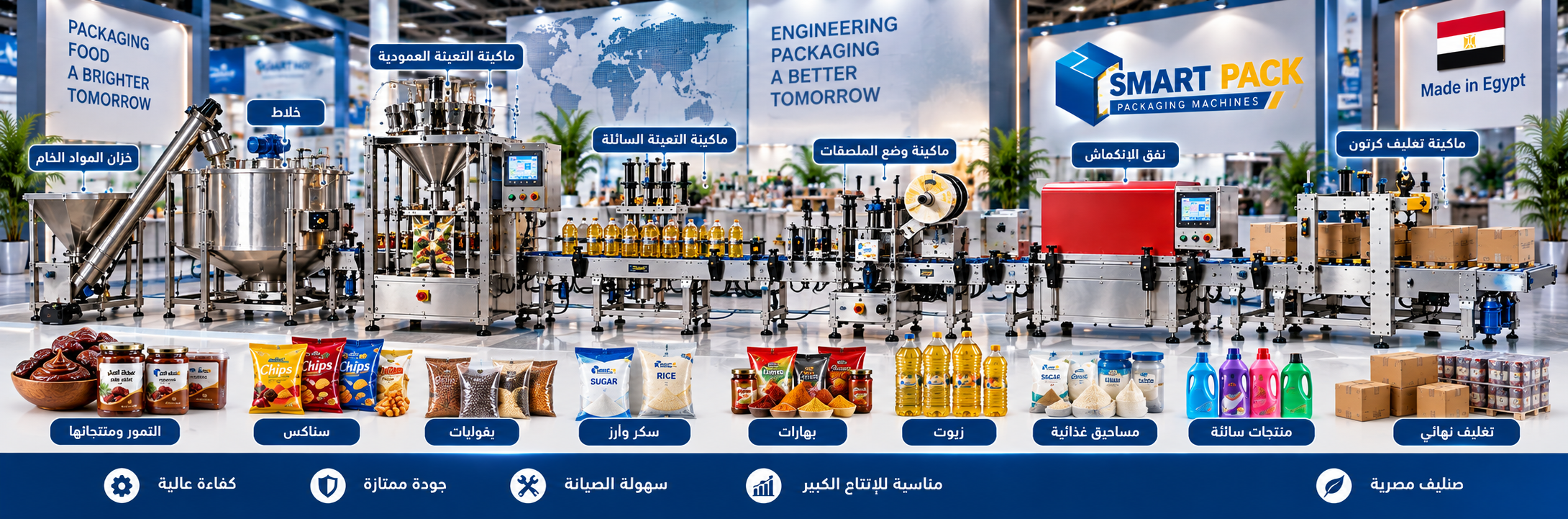
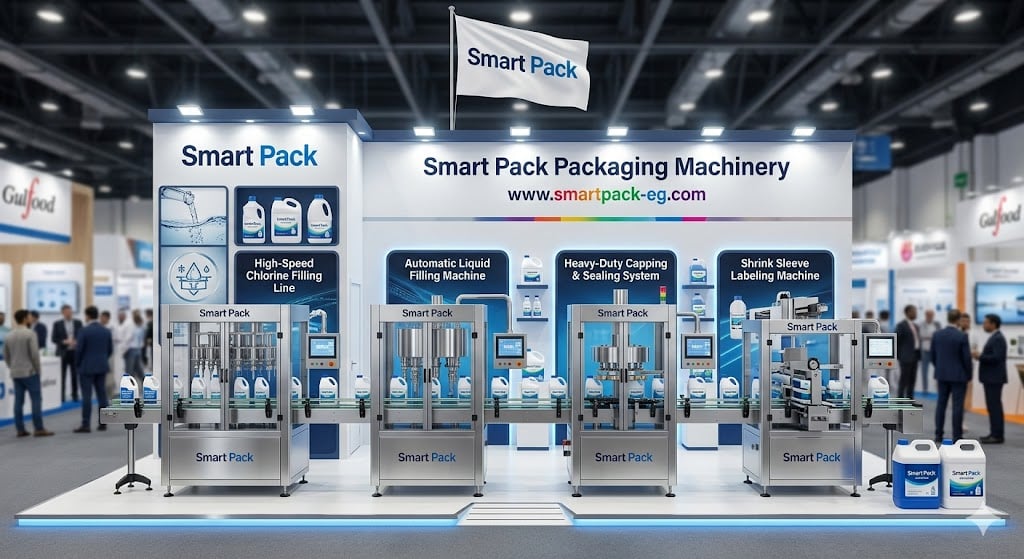
At this stage, many manufacturers choose partners with proven expertise in chemical filling and packaging machinery, such as Smart Pack, as they provide more than just equipment. They assist with:
-
Selecting the appropriate capacity
-
Choosing safe filling systems
-
Designing scalable production lines
-
Providing continuous technical support
Market Study and Profitability of the Chlorine Manufacturing Project
The chlorine market is highly stable due to:
-
Daily demand
-
Strong connection to hygiene and public health
-
Easy storage
-
Low production cost compared to selling price
With proper management, factories can achieve:
-
Healthy profit margins
-
Fast capital turnover
-
Long-term supply contracts
Especially when serving both household and industrial markets.
Investment Tips Before Entering the Chlorine Industry
-
Focus on quality, not price alone
-
Choose practical and safe packaging
-
Invest in reliable filling machines
-
Plan for expansion from the beginning
These factors determine project success in the medium and long term.
Is a Chlorine Project Suitable for Small Factories?
Yes. Production can start with a flexible line and expand gradually.
Can Household and Industrial Chlorine Be Produced on the Same Line?
Yes, with minor differences in concentration and packaging.
Does Packaging Affect Sales?
Directly, as it reflects product quality and safety.
Is Export Possible?
Yes, when specifications and packaging standards are met.
When Does ROI Typically Begin?
In a relatively short period with proper management.
The Smart Industrial Decision Starts with Choosing the Right Production Line
Chlorine manufacturing, filling, and packaging is no longer a simple activity—it is a fully integrated industrial project capable of delivering stable profits when properly planned.
Factories that invest in well-designed filling and packaging machines and complete production lines, and that choose specialized suppliers such as Smart Pack, position themselves strongly in a market that continues to grow without interruption.