 Admin
Admin Steps to Set Up a Professional Filling & Packaging Production Line
From Idea to Full Operation and Higher Factory Capacity
Start right, grow fast, and produce with confidence.
A factory built on proper engineering planning accelerates quickly, while randomly installed equipment causes costly mistakes for years.
The difference between an average plant and a highly profitable industrial operation lies in strategically selecting and integrating filling and packaging machines from day one.
If you’re planning to build or upgrade a professional production and packaging facility, this step-by-step guide gives you a clear execution roadmap to minimize costs and maximize profits.
Phase 1 – Engineering Planning for Packaging Factories
4
Study the project before buying any machines
• Define your sector: food, detergents, chemicals, liquids, powders
• Identify your target market and customers
• Calculate required daily production capacity
• Estimate budget for production lines and equipment
• Determine factory size and workflow paths
Why this phase is critical
Poor planning may cause:
• Congestion inside the factory
• Interrupted material flow
• Wasted space
• Higher operating costs
Good planning can save up to 30% in future operating expenses.
Phase 2 – Define Product Specifications & Packaging Type
4
Packaging shape determines machine selection
• Bottles or jerrycans
• Bags or pouches
• Plastic or glass containers
• Cartons or shrink packs
Define product characteristics
• Light liquids
• Viscous liquids (detergents, shampoo, soap)
• Powders
• Granules or solids
Each category requires specific filling technology.
There is no “one machine fits all” solution.
Phase 3 – Select Integrated Filling & Packaging Lines
4
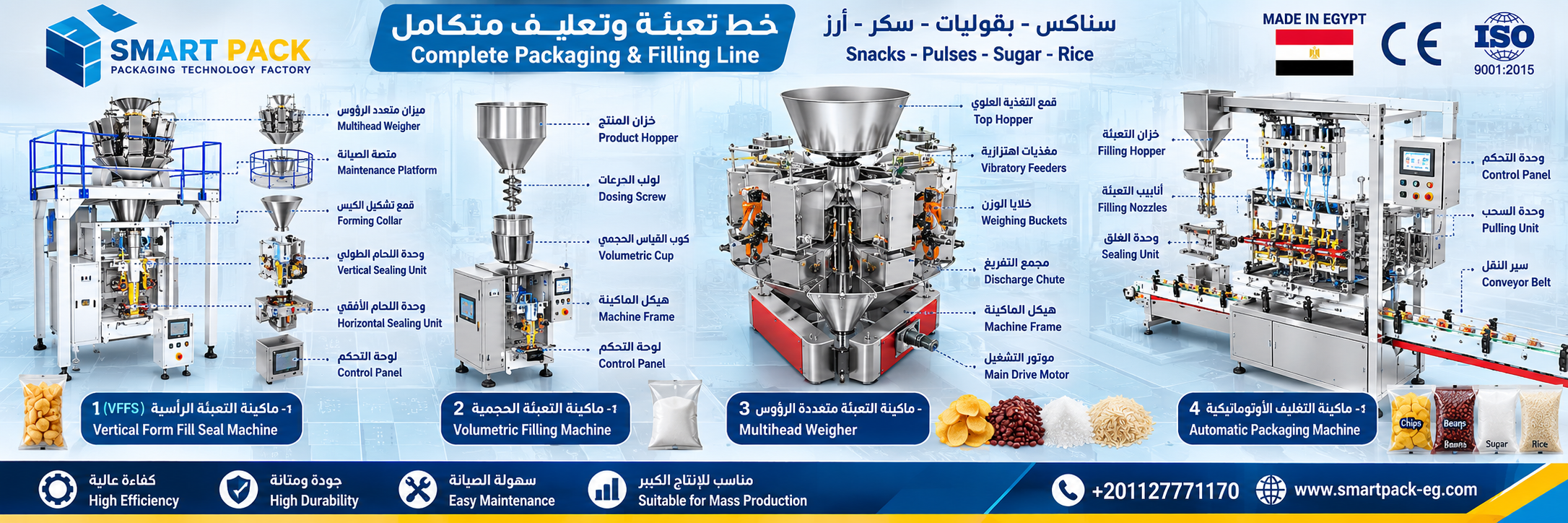
Typical production line components
A complete industrial line usually includes:
• Product tank or feeding system
• Filling machine
• Capping or sealing machine
• Labeling or coding machine
• Wrapping or shrink machine
• Cartoning and palletizing unit
• Automatic conveyor systems
Engineering tip
Buying a complete line from one supplier is better than combining separate machines.
It ensures mechanical compatibility and easier maintenance.
Phase 4 – Compare Machine Types to Choose the Right One
Filling & Packaging Line Comparison
Factor | Semi-Automatic | Automatic | High-Speed Integrated Lines
Usage | Small startups | Medium factories | Large/export plants
Speed | 10–20 packs/min | 30–60 packs/min | 80–150+ packs/min
Labor required | High | Medium | Very low
Accuracy | Medium | High | Very high
Investment | Low | Medium | Higher but strong ROI
Profitability | Limited | Good | Very high & long-term
Choosing the right automation level directly impacts productivity and profits.
Phase 5 – Prepare Factory Infrastructure
4
Essential requirements
• Stable industrial electricity
• Air compressors for pneumatic systems
• Level, water-resistant floors
• Drainage and hygiene systems
• Raw material and finished goods storage
Ignoring these basics leads to:
• Frequent breakdowns
• Production stoppages
• Reduced efficiency
Infrastructure is just as important as the machines themselves.
Phase 6 – Installation & Trial Operation
4
Pre-launch steps
• Install machines and connect conveyors
• Configure programming and speeds
• Calibrate weight/volume accuracy
• Dry run without product
• Trial production with small batches
• Train operators
Benefits
• Early fault detection
• Quality assurance
• Avoid costly losses at official launch
Market Study, Costs & Profitability
4
Investment insights
• Demand for packaged products keeps growing
• Export markets increase margins
• Automatic machines lower unit production costs
Example financial model
Item | Estimate
Production line investment | $150,000 – $250,000
Monthly operating cost | $55,000
Expected monthly output | 400,000 – 600,000 packs
Monthly sales | $95,000 – $130,000
Potential monthly profit | $35,000 – $50,000
Payback period | 12–16 months
These numbers show how modern automation delivers fast and strong returns.
Smart Buying Tips
• Choose suppliers offering complete integrated solutions
• Visit working factories using the same equipment
• Ensure fast maintenance support
• Focus on heavy-duty industrial quality
• Work with experienced providers like Smart Pack for turnkey systems
A reliable partner reduces downtime and boosts productivity from day one.
Frequently Asked Questions
What is the first step when setting up a packaging factory?
Study the product and capacity, then design an engineering layout.
Should I buy a single filling machine or a full line?
A complete line is better for compatibility and smoother operation.
How are detergent fillers different?
They require special systems to handle viscosity, foam, and leakage prevention.
How long does installation take?
Typically 2–6 weeks depending on project size.
Is investing in automatic lines profitable?
Yes. Higher speed and lower labor costs significantly increase margins.