 Admin
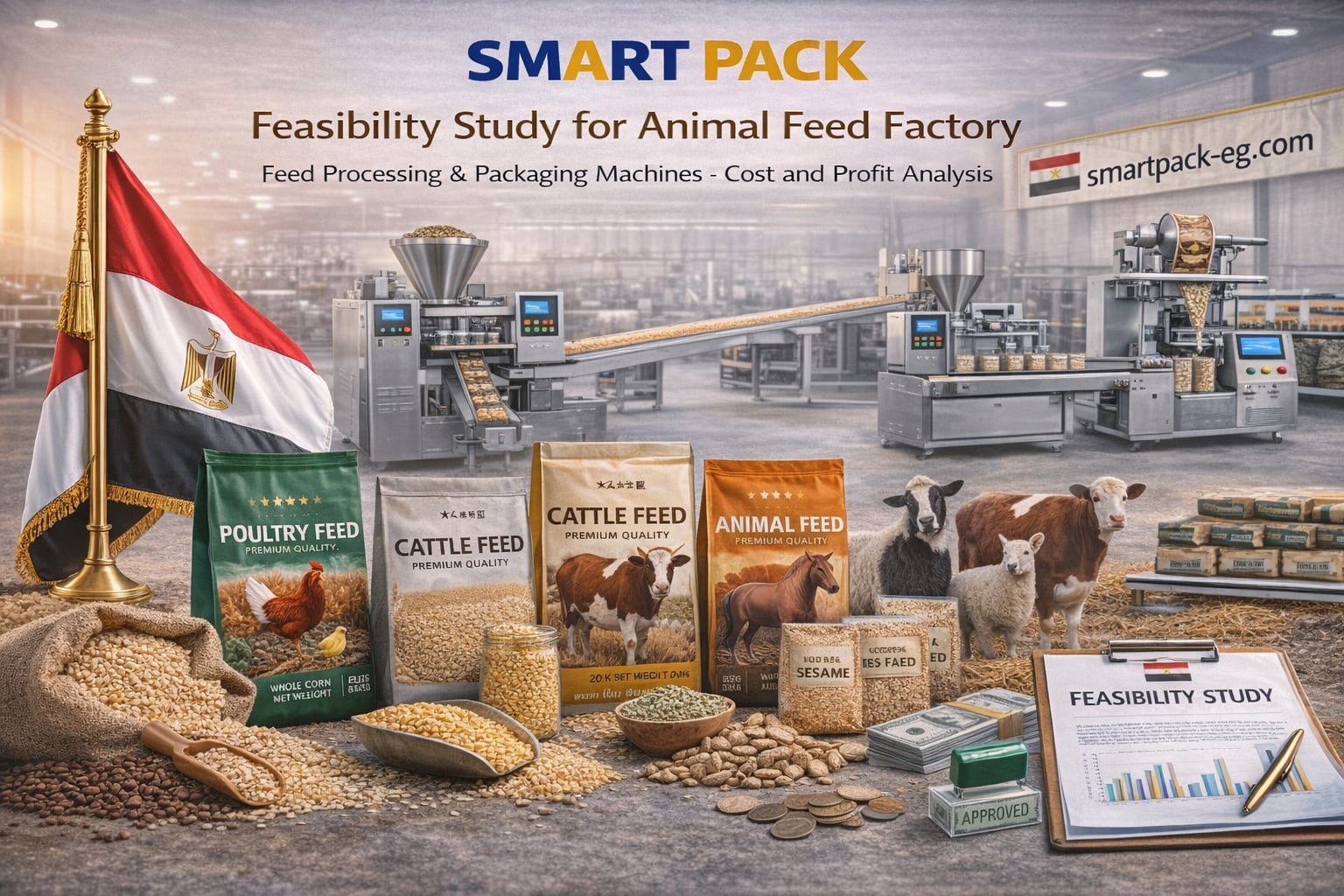
Admin Animal Feed Factory Project in Egypt: A Comprehensive Feasibility Study for Profitable Industrial Success
The animal feed factory project is considered one of the most vital industrial projects in Egypt, driven by the rapidly growing demand for livestock, poultry, and aquaculture feed alongside the expansion of animal production and fish farming projects.
The success of this project does not rely solely on the availability of raw materials—it fundamentally depends on a well-prepared feasibility study, the selection of a fully integrated production line, and the use of professional filling and packaging machines that ensure product quality and smooth market distribution.
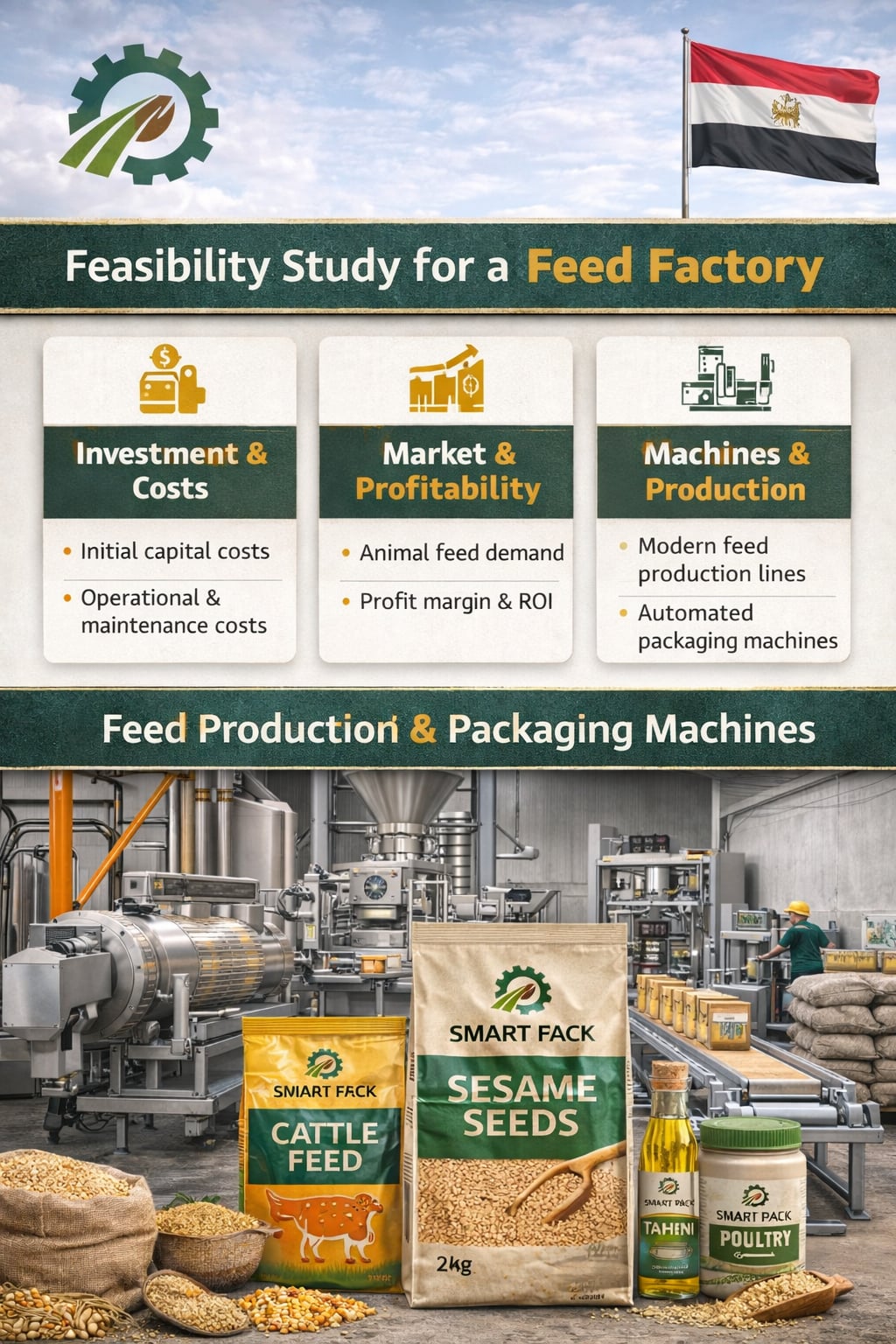
In this article, we present a complete feasibility study for an animal feed factory project in Egypt, covering technical and production aspects, the importance of packaging machines, practical investor tips, and the role of Smart Pack in equipping production lines.
First: The Importance of an Animal Feed Factory Project in Egypt
The feed sector is a cornerstone of food security, as feed quality directly impacts meat, poultry, and fish production. The importance of this project lies in:
-
Increasing local demand for animal feed
-
Continuous reliance of farms on stable feed suppliers
-
Strong potential for export to neighboring markets
-
Relatively fast capital turnover
These factors make animal feed factories a highly profitable investment when properly implemented.
Second: Main Raw Materials Used in Feed Manufacturing
Feed production depends on carefully balanced raw materials, including:
-
Yellow corn
-
Soybean meal
-
Wheat bran
-
Mineral salts
-
Vitamins
-
Nutritional additives
Raw material quality has a direct impact on final feed quality, making reliable suppliers essential.
Third: Feed Production Stages Inside the Factory
Animal feed production goes through several key stages:
1. Grinding
Raw materials are ground to achieve a suitable particle size for mixing.
2. Mixing
Ingredients are mixed in precise ratios to ensure uniform feed composition.
3. Pelleting or Crumbling
Feed is processed into pellets or meal depending on usage.
4. Cooling
Cooling preserves nutritional properties after pelleting.
5. Filling and Packaging
The final stage prepares the product for storage and distribution.
Fourth: The Importance of Feed Filling and Packaging Machines
Packaging plays a critical role in:
-
Protecting feed from moisture and spoilage
-
Facilitating storage and transportation
-
Enhancing product appearance and branding
-
Ensuring consistent weight and accuracy
Modern packaging machines significantly reduce waste and increase factory efficiency.
Fifth: Types of Animal Feed Filling and Packaging Machines
| Machine Type | Usage | Advantages |
|---|---|---|
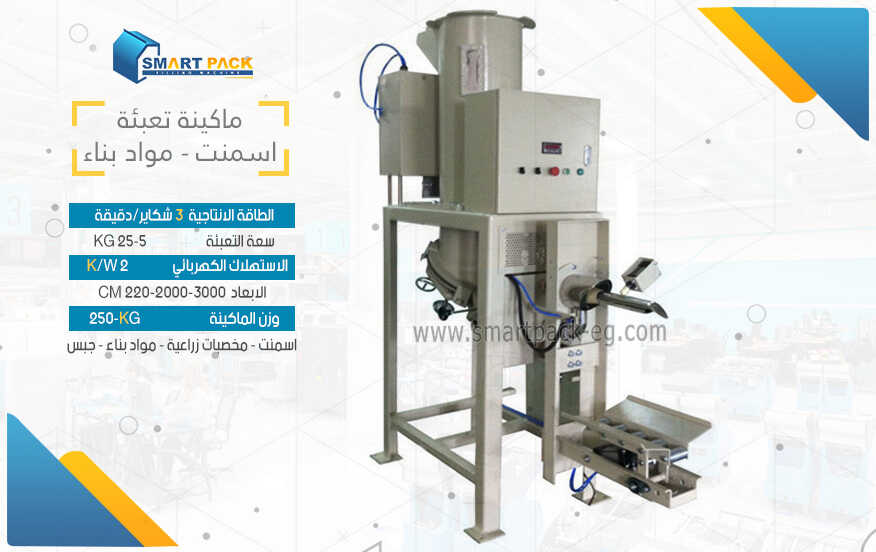
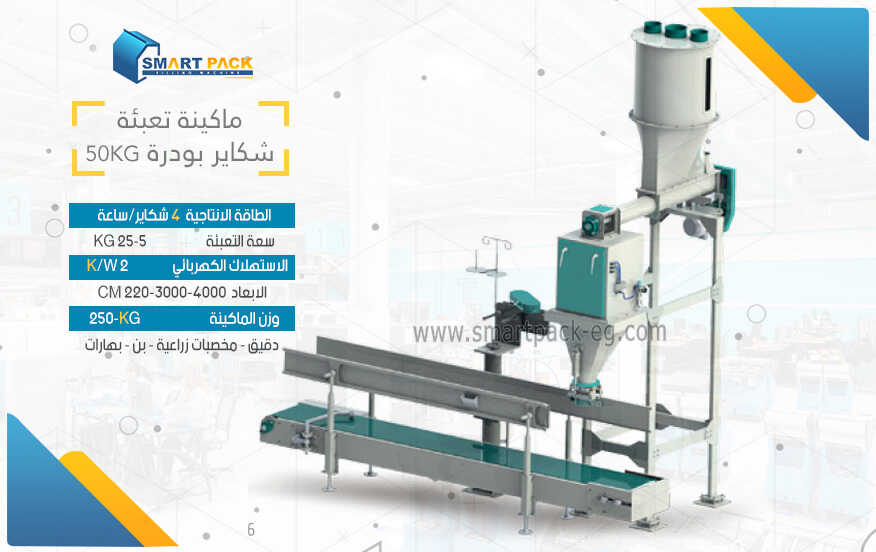
| Weighing Filling Machines | Bag filling | High weight accuracy |
| Automatic Filling Machines | High-volume production | Speed & efficiency |
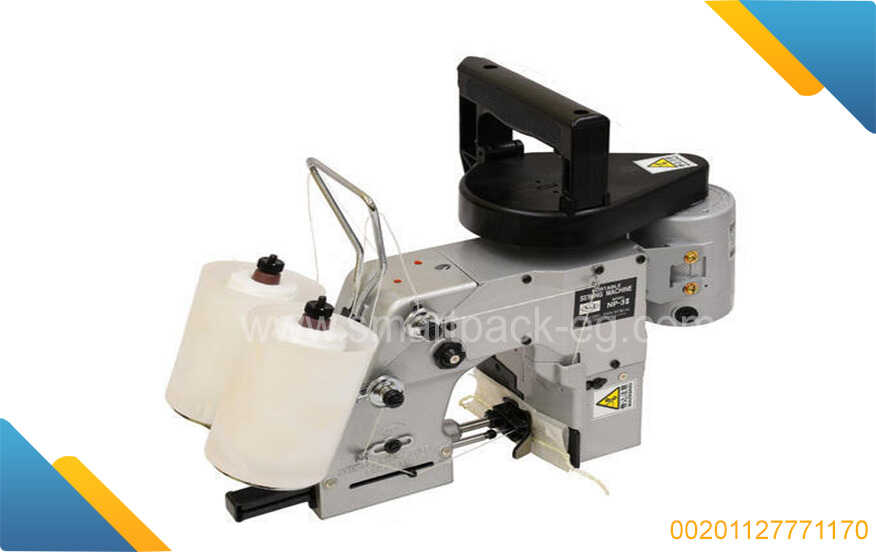
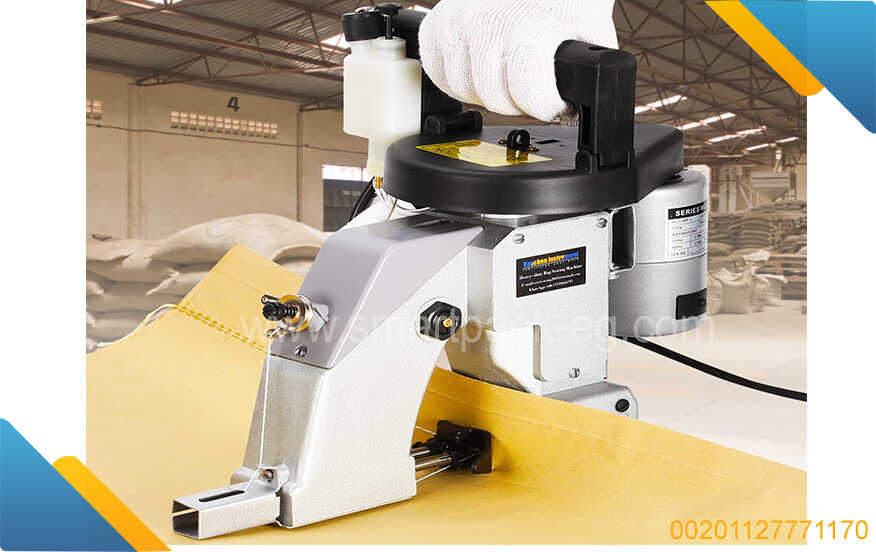
| Bag Sealing Machines | Bag closing | Tight sealing |
| External Packaging Machines | Bundle packing | Easy handling |
Sixth: Technical Feasibility Study for a Feed Factory
The technical study defines:
-
Daily production capacity
-
Required factory space
-
Workforce size
-
Power and energy consumption
-
Type of production lines
Choosing the right capacity from the start helps reduce operating costs and maximize ROI.
Seventh: Simplified Economic Feasibility Overview
| Item | Impact |
|---|---|
| Raw material costs | Largest cost component |
| Machinery costs | Long-term investment |
| Labor | Fixed operating cost |
| Packaging | Key marketing element |
| Profits | Linked to volume & quality |
A clear feasibility study ensures strong decision-making before launch.
Eighth: How to Choose the Right Filling and Packaging Machines
Correct selection depends on:
-
Expected production volume
-
Type of feed (pelleted or mash)
-
Bag sizes (25–50 kg)
-
Required automation level
-
Ease of maintenance and spare parts availability
Early smart choices minimize downtime and boost efficiency.
Ninth: Why Choose Smart Pack Solutions?
Smart Pack delivers complete solutions for animal feed factories, including:
-
Custom-designed filling and packaging lines
-
High-precision, heavy-duty machines
-
Technical support and after-sales service
-
Operator training
-
Future expansion and upgrades
Partnering with a specialized company significantly reduces operational risks and ensures continuity.
Tenth: Key Tips for a Successful Feed Factory Project
-
Don’t choose machines based on price alone
-
Always test machines before purchase
-
Select equipment designed for continuous operation
-
Commit to regular maintenance
-
Invest in high-quality packaging—it reflects product quality
Eleventh: Product Journey from Factory to Market
-
Feed production
-
Filling and packaging
-
Storage
-
Transportation
-
Distribution
-
Sales to farms and customers
Each stage directly impacts brand reputation and demand stability.
Frequently Asked Questions (FAQ)
1. Is an animal feed factory profitable in Egypt?
Yes, with a solid feasibility study and proper management.
2. What is the most common feed bag weight?
25 kg and 50 kg are industry standards.
3. Can I start with small production capacity?
Yes, with the option to expand later.
4. Is manual packaging suitable?
Not recommended for medium and large factories due to waste.
5. Do packaging machines require regular maintenance?
Yes, to maintain accuracy and machine lifespan.
6. Does Smart Pack provide pre-installation consultation?
Yes, including full technical studies before installation.
Conclusion
The animal feed factory project in Egypt is a promising industrial opportunity, but its success depends on proper planning, integrated production lines, and professional filling and packaging machines.
Relying on a trusted industrial partner like Smart Pack ensures high-efficiency execution, stable production, and a competitive final product in both local and export markets.